Who Is Eligible for Green Certificate in Punjab? Complete Eligibility Guide 2026
Quick Answer: If your business operates in Punjab and has any environmental impact—whether manufacturing, processing, waste generation, or service provision—you likely need to obtain a Green Certificate for legal compliance in 2026. Eligibility depends on your industry type, operational scale, and environmental footprint, not your business size.
Understanding Green Certificate Eligibility
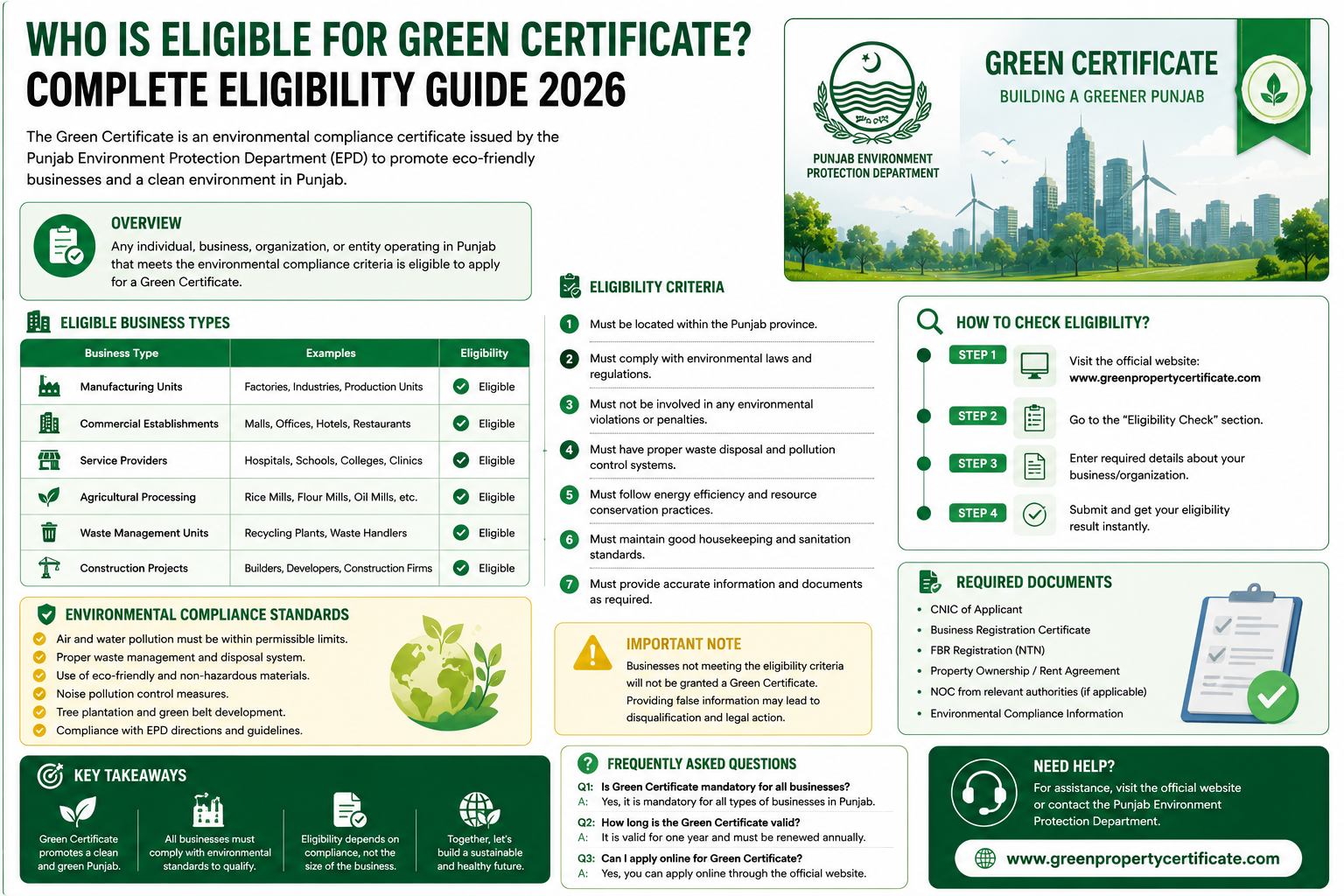
The question “Am I eligible for a Green Certificate?” is one of the most critical decisions Pakistani business owners face in 2026. Unlike many certification programs that are optional, green certification eligibility is often mandatory for specific industry categories under Punjab’s new environmental regulations. The misconception that only large factories need certification has cost many business owners dearly—penalties can reach 5 million PKR, and operations can be suspended entirely.
Green Certificate eligibility isn’t about business size. A micro-enterprise generating significant chemical waste is more likely to need certification than a 100-person IT company operating in an office. Eligibility hinges on whether your activities produce environmental impact that requires monitoring, control, and compliance with national environmental quality standards.
Understanding your eligibility status early prevents costly delays, helps you budget for compliance investments, and positions your business as an environmentally responsible operation—a competitive advantage in today’s market.
Who Qualifies for Green Certificate: Complete Business Category Breakdown
Manufacturing and Industrial Operations
Manufacturing facilities represent the largest category requiring green certification. Any business involved in converting raw materials into finished products must comply with environmental standards:
- Textile Mills: Fabric production, dyeing, printing, and finishing operations require certification due to water usage and chemical discharge.
- Food Processing: Dairy plants, beverage production, meat processing, and bakery operations at commercial scale need certification.
- Chemical Manufacturing: Production of pharmaceuticals, cosmetics, cleaning products, and industrial chemicals mandates certification.
- Metal and Engineering: Steel foundries, aluminum processing, automotive parts manufacturing, and welding operations require documentation.
- Cement and Construction Materials: Cement plants, brick kilns, tile manufacturing, and stone processing operations need certification.
- Rubber and Plastic Manufacturing: Production facilities for plastic bags, containers, pipes, and rubber products require environmental approval.
Energy and Utilities Sector
Businesses generating, distributing, or managing energy resources fall under mandatory certification requirements:
- Power Generation: Thermal power plants, hydroelectric facilities, and renewable energy installations must obtain certification.
- Oil and Gas Operations: Extraction, refining, storage, and distribution of petroleum products require environmental compliance documentation.
- Natural Gas Distribution: Companies operating gas pipelines and distribution networks need certification.
- Renewable Energy: Solar panels manufacturing, wind turbine installations, and biogas production facilities require certification.
Extraction and Mining Industries
Any business extracting natural resources from earth requires green certification for environmental protection:
- Mining Operations: Coal, minerals, and gemstone extraction require comprehensive environmental documentation.
- Stone Crushing: Quarries and stone crushing units generating dust and noise need certification.
- Sand and Gravel Extraction: Riverbed mining and sand extraction operations require environmental approval.
- Brick Manufacturing: Clay extraction and brick kiln operations need certification.
Agriculture and Animal Husbandry
Large-scale agricultural operations and animal farms increasingly require certification:
- Commercial Farms: Operations using pesticides or employing 50+ workers need certification.
- Dairy Farms: Large-scale dairy operations with 100+ cattle require environmental compliance documentation.
- Poultry Farms: Commercial chicken, duck, and bird farms need certification for waste management.
- Fish Farming: Aquaculture operations require water quality and waste management certification.
- Agricultural Processing: Sugar mills, rice mills, cotton gins, and vegetable processing units need certification.
Waste Management and Recycling
Any business handling, processing, or disposing of waste must obtain certification:
- Recycling Centers: Paper, plastic, metal, and glass recycling facilities require certification.
- Waste Treatment Plants: Composting, biomedical waste treatment, and hazardous waste processing need documentation.
- Landfill Operations: Solid waste disposal and landfill management require comprehensive environmental certification.
- Electronic Waste Recycling: E-waste dismantling and component recovery operations need certification.
Transportation and Logistics
Fleet-based businesses with significant vehicle operations require certification:
- Logistics Companies: Large fleets (50+ vehicles) need emission and maintenance documentation.
- Ride-Sharing Services: Commercial vehicle operations require environmental compliance certification.
- Public Transportation: Bus operators and commercial transport services need certification.
Construction and Real Estate
Major construction projects and real estate developments require certification:
- Large Development Projects: Housing societies, commercial complexes, and infrastructure projects need environmental impact assessment and certification.
- Construction Companies: Contractors handling multiple projects require overall environmental management certification.
- Infrastructure Development: Road construction, dam building, and utility installation projects require certification.
Hospitality and Service Sector
While less common, large hospitality and service establishments may require certification:
- Large Hotels: 5-star hotels and resorts with 200+ rooms often need certification for water and waste management.
- Hospitals and Clinics: Large medical facilities handling biomedical waste require certification.
- Educational Institutions: Universities and large schools may need certification depending on campus infrastructure.
The Eligibility Decision Tree: Is Your Business Covered?
| Key Question | Answer: Yes | Answer: No |
|---|---|---|
| Does your business involve manufacturing, processing, or chemical transformation? | Likely Eligible – Proceed with environmental assessment | Move to next criteria |
| Do you generate, discharge, or dispose of hazardous or industrial waste? | Likely Eligible – Certification required | Move to next criteria |
| Does your operation consume significant water (>10,000 liters/day)? | Likely Eligible – Assess waste water treatment | Move to next criteria |
| Are you in mining, quarrying, or natural resource extraction? | Definitely Eligible – Certification mandatory | Move to next criteria |
| Do you employ 50+ staff with operational activities (not offices)? | Likely Eligible – Conduct environmental audit | Move to next criteria |
| Do your operations generate noise >70dB during working hours? | Likely Eligible – Implement controls and certify | Probably Not Eligible |
Critical Eligibility Factors: Beyond Business Category
1. Environmental Impact Assessment (EIA) Requirement
Businesses requiring environmental impact assessments fall under mandatory certification. An EIA is necessary if your operation significantly affects:
- Air quality through emissions or dust generation
- Water bodies through discharge or contamination
- Soil quality through chemical or hazardous waste
- Noise levels affecting nearby residential areas
- Ecological systems or protected areas
- Public health through pollution
2. Scale and Operational Intensity
While small operations may have exemptions, eligibility often depends on operational intensity:
- Daily Production Volume: Does your facility produce more than 100 units/day?
- Staff Strength: Do you employ 10+ workers in operational roles?
- Equipment Count: Do you operate 5+ machines or industrial equipment?
- Operating Hours: Do you operate in shifts or 24/7?
- Raw Material Quantity: Do you consume 1+ ton of raw materials daily?
3. Hazardous Material Handling
Any business handling chemicals classified as hazardous automatically qualifies for mandatory certification. This includes:
- Pesticides and fertilizers
- Industrial chemicals and solvents
- Petroleum products and fuels
- Pharmaceutical compounds
- Cleaning and sanitizing agents
- Heavy metals and toxic substances
4. Waste Generation Category
The type and quantity of waste your business generates determines eligibility:
Hazardous Waste (Any Amount): Automatic eligibility requirement. Any hazardous waste generation mandates certification.
Non-Hazardous Industrial Waste (>500 kg/day): Eligibility likely required for proper management and disposal.
General Business Waste (<500 kg/day): May be exempt if waste is standard office/retail garbage not requiring special handling.
Special Eligibility Categories and Exemptions
Potential Exemptions
The following business types may qualify for exemption or simplified certification:
- Small Service Businesses: Pure service providers (consulting, accounting, legal services) with minimal environmental impact
- Retail and Trading: General retail shops and wholesale trading without processing or manufacturing
- IT and Software Services: Software companies and tech services operating from offices without industrial equipment
- Professional Services: Medical clinics (non-hospital), educational centers without large-scale operations
- Home-Based Micro-Enterprises: Very small operations (1-3 staff) with negligible environmental footprint
Key Takeaways
What You Must Know About Green Certificate Eligibility
- Eligibility is determined by environmental impact, not business size. A small factory is more likely to need certification than a 100-person office.
- Manufacturing, industrial, mining, energy, and waste management businesses are automatically eligible and cannot claim exemption.
- Any business handling hazardous materials requires certification regardless of scale or profit status.
- The 2026 regulations expanded eligible categories significantly—verify your status immediately if you haven’t already.
- Non-compliance penalties range from substantial fines to operational suspension, making it critical to confirm eligibility early.
- Certification is valid for 3 years; plan renewal timelines now if your certificate approaches expiration.
- Even if your current category seems exempt, significant operational changes require reassessment of eligibility status.
Frequently Asked Questions: Green Certificate Eligibility
Next Steps: Confirming Your Eligibility and Moving Forward
Once you’ve determined your likely eligibility status, the next critical steps are clear:
Action Checklist for Eligible Businesses
- ✓ Document your determination: Keep records showing why your business is eligible. This protects you legally if ever questioned.
- ✓ Conduct environmental audit: Hire a certified environmental consultant to assess your current compliance level and identify gaps.
- ✓ Budget for improvements: Invest in necessary pollution control equipment, waste management systems, or process modifications.
- ✓ Gather documentation: Compile licenses, certificates, utility records, equipment specifications, and operational procedures.
- ✓ Submit application: Work with your environmental consultant to prepare and file your Green Certificate application with PEPD.
- ✓ Prepare for inspection: Ensure your facility meets stated standards before the official site inspection and testing.
Understanding Eligibility Helps You Plan Better
Green Certificate eligibility isn’t punitive—it’s a framework that ensures environmental responsibility becomes standard practice. Businesses that understand their eligibility early can:
- Budget Appropriately: Plan capital investments in compliance equipment and infrastructure improvements over time rather than facing rushed, expensive solutions.
- Hire Right Consultants: Engage certified environmental professionals who understand your specific industry requirements rather than generic advisors.
- Gain Market Advantage: Achieve certification before competitors, positioning yourself as the environmentally responsible choice in your market.
- Avoid Penalties: Comply proactively rather than reactively, preventing fines, operational suspension, and reputational damage.
- Improve Operations: Use compliance requirements as an opportunity to optimize costs, reduce waste, and improve efficiency simultaneously.
Related Reading: Once you’ve confirmed eligibility, explore the complete Green Certificate requirements and step-by-step application process on our resource pages.
Your Eligibility, Your Responsibility
Determining whether you’re eligible for a Green Certificate in Punjab is your first responsibility as a business owner. This isn’t optional assessment—it’s legal compliance. The regulatory landscape in 2026 is clear: environmental responsibility is non-negotiable, and businesses must operate within established environmental frameworks.
Your eligibility status isn’t final; it evolves as your business grows or changes. What’s exempt today might be eligible tomorrow if you expand operations or introduce new processes. Stay informed, verify your status with PEPD regularly, and maintain compliance throughout your business lifecycle.
Ready to Verify Your Green Certificate Eligibility?
Don’t wait for warnings or penalties. Contact the Punjab Environmental Protection Department today to confirm your business status and understand exactly what’s required for compliance.
Start Your Eligibility Assessment