Understanding Green Certificate Requirements in Punjab 2026
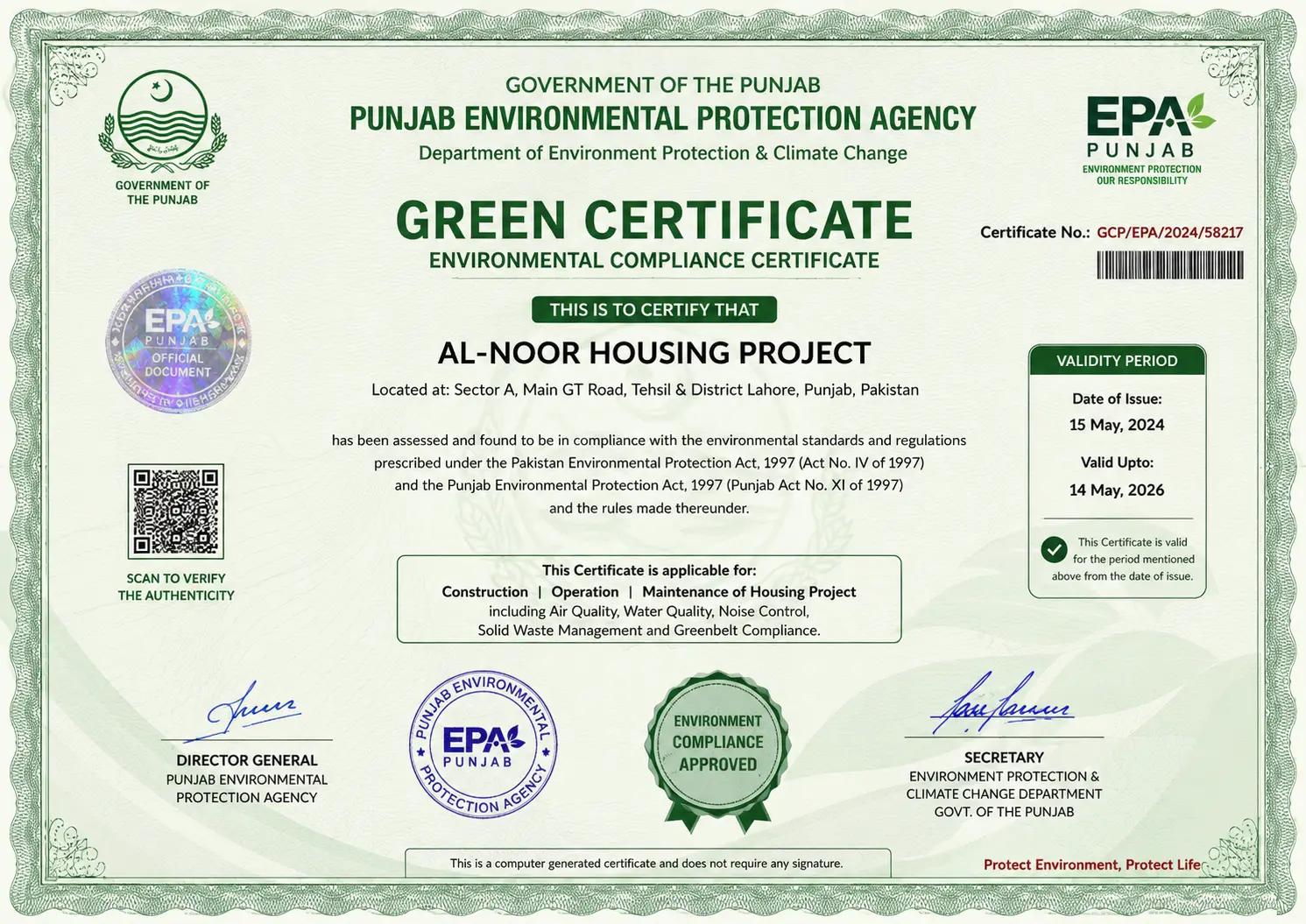
Green Certificate requirements in Punjab set the environmental standards your business must meet to receive official certification from the Punjab Environmental Protection Department (PEPD). These aren’t arbitrary rules they’re designed to protect air quality, water resources, soil integrity, and community health.
Whether your business needs a Green Certificate depends on multiple factors: business size, industry type, environmental impact, and operational processes. Not every business requires certification, but if yours does, understanding these requirements upfront saves time, money, and prevents costly rejections.
✓ Quick Answer
Green Certificate requirements include: eligibility verification (business type/size), environmental compliance with 6 major standards (air quality, water management, waste disposal, noise control, energy efficiency, management systems), comprehensive documentation (20+ documents), site inspection approval, and laboratory testing showing compliance. Requirements vary by industry—manufacturing faces stricter standards than service businesses.
Part 1: Eligibility Requirements – Does Your Business Need Certification?
Business Types That REQUIRE Green Certificate
The following business categories are mandated to obtain Green Certificate under 2026 Punjab regulations:
Manufacturing Industries
All manufacturing operations must obtain certification, including:
- Textile mills and fabric production facilities
- Chemical factories and pharmaceutical manufacturers
- Food processing plants and beverage production
- Cement and construction material plants
- Steel and metal manufacturing
- Automotive parts and assembly plants
- Electronics and electrical manufacturing
- Leather tanning and processing units
Energy Production Facilities
All energy generation operations require certification:
- Thermal and coal-based power plants
- Natural gas and fuel-based generators
- Large-scale solar installations (50+ KW)
- Wind energy farms
- Hydroelectric power stations
- Biogas and biomass facilities
- Diesel generators (continuous use)
Mining & Extraction Operations
All extraction and quarrying operations need certification:
- Stone crushing and quarrying units
- Sand and gravel extraction
- Mineral mining operations
- Salt mining and processing
- Coal mining operations
- Rock and aggregate extraction
Large-Scale Agricultural Operations
Agricultural businesses meeting these criteria require certification:
- Farms using chemical pesticides or fertilizers (>50 acres)
- Dairy operations with 100+ animals
- Poultry farms with 5,000+ birds
- Large-scale greenhouse operations
- Fish farming and aquaculture facilities
- Sugar mills and distilleries
Construction & Real Estate Development
Construction projects and developers require certification:
- Large construction projects (>5 acres)
- Real estate development complexes
- Infrastructure and highway projects
- Housing society development
- Commercial complex construction
- Bridge and tunnel projects
Waste Management Facilities
Waste-related operations must obtain certification:
- Waste recycling and processing centers
- Hazardous waste treatment facilities
- Landfill and waste disposal sites
- Waste incineration plants
- Wastewater treatment facilities
- Composting and biosolid facilities
Business Types EXEMPT From Certification
Small businesses and service providers with minimal environmental impact may be exempt:
| Business Category | Exemption Criteria |
|---|---|
| Retail Shops & Stores | No manufacturing or chemical use |
| Office & Administrative | Pure office work, <10 employees |
| Professional Services | Consultants, lawyers, accountants |
| Small Restaurants | Kitchen waste management in place |
| Beauty & Salon Services | No hazardous chemical discharge |
| Educational Institutions | No lab/workshop operations |
| Health Clinics | <50 beds, proper waste disposal |
| E-Commerce & Logistics | Storage only, no manufacturing |
General Rule: If your business has fewer than 10 employees and generates no manufacturing waste, hazardous materials, or significant emissions, you’re likely exempt. However, verify with PEPD—misclassifying your business can result in penalties.
Part 2: Environmental Compliance Standards You Must Meet
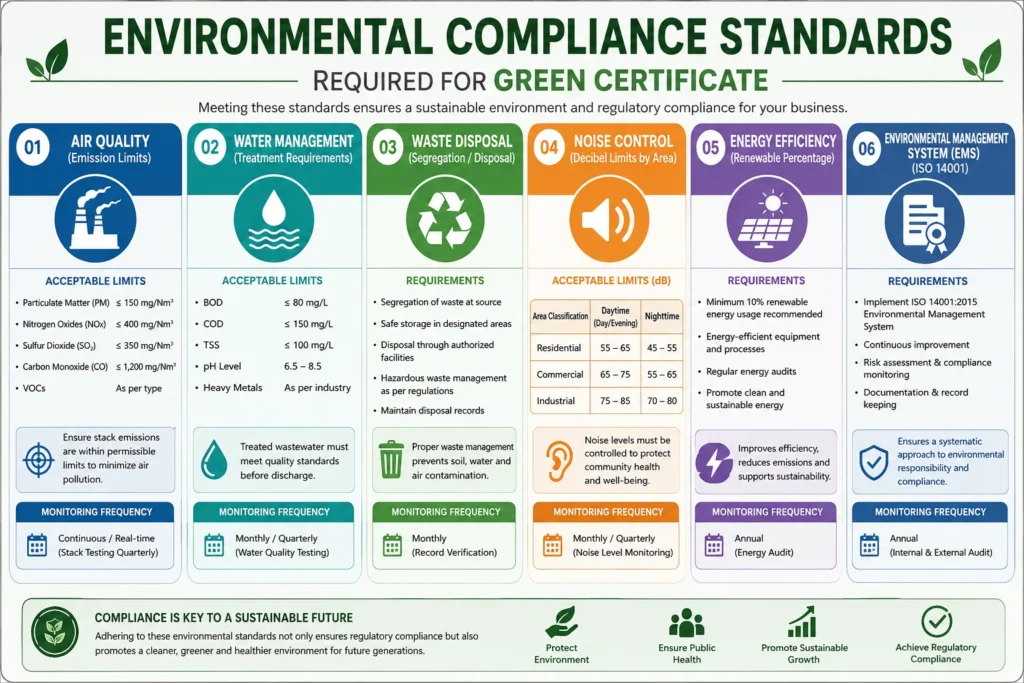
Green Certificate requirements include meeting six major environmental standards. Your facility must comply with all applicable standards based on your industry classification.
Standard 1: Air Quality Compliance
Air quality is the most strictly monitored environmental parameter. Your business must control emissions and meet National Environmental Quality Standards (NEQS) for air.
| Emission Type | Allowable Limit (mg/Nm³) | Monitoring Method |
|---|---|---|
| Particulate Matter (PM) | 150 mg/Nm³ | Stack testing, air quality monitoring |
| Nitrogen Oxides (NOx) | 400 mg/Nm³ | Continuous emissions monitoring |
| Sulfur Dioxide (SO₂) | 350 mg/Nm³ | Stack emissions testing |
| Carbon Monoxide (CO) | 1,200 mg/Nm³ | Combustion equipment monitoring |
| Volatile Organic Compounds (VOCs) | Varies by type | Process control measures |
What you need: Proper stack monitoring systems, dust collection equipment, scrubbers, or filters depending on your industry. Annual third-party air quality testing is required.
Standard 2: Water Management & Wastewater Treatment
Businesses using water must properly treat and manage discharge to meet water quality standards.
| Water Parameter | Acceptable Limit (mg/L) | Requirement |
|---|---|---|
| Biological Oxygen Demand (BOD) | ≤ 80 mg/L | Treatment plant required |
| Chemical Oxygen Demand (COD) | ≤ 150 mg/L | Pre-treatment systems |
| Total Suspended Solids (TSS) | ≤ 100 mg/L | Settling tanks, filters |
| pH Level | 6.5 – 8.5 | Neutralization if needed |
| Heavy Metals | Variable (industry-specific) | Precipitation/removal systems |
What you need: Wastewater treatment facility (engineered or natural), groundwater protection measures, proper disposal records, quarterly water testing reports.
Standard 3: Waste Disposal & Management
Hazardous and non-hazardous waste must be properly segregated, treated, and disposed of.
- Waste Segregation: Separate hazardous from non-hazardous waste at source
- Hazardous Waste: Must be treated by authorized facilities only (not dumped locally)
- Medical/Biological Waste: Incineration or special treatment required
- Solid Waste: Daily collection, proper storage, and disposal to licensed landfills
- Recycling Program: Implement waste reduction and recycling where possible
- Documentation: Maintain waste generation, treatment, and disposal records
Standard 4: Noise Level Compliance
Noise emissions are measured in decibels (dB) and vary by area classification:
| Area Classification | Daytime (Day/Evening) | Nighttime | Examples |
|---|---|---|---|
| Residential | 55 – 65 dB | 45 – 55 dB | Housing areas, schools |
| Commercial | 65 – 75 dB | 55 – 65 dB | Markets, offices, shops |
| Industrial | 75 – 85 dB | 70 – 80 dB | Factories, plants, mills |
What you need: Noise monitoring system, sound insulation, equipment maintenance records, quarterly noise level measurements by certified labs.
Standard 5: Energy Efficiency Requirements
Since 2026, all certified businesses must demonstrate energy efficiency and renewable energy usage:
- Renewable Energy Component: Minimum 5-10% of total energy from renewable sources (solar, wind, biogas)
- Energy Audit: Annual third-party energy consumption audit required
- Efficient Equipment: Use energy-star rated or equivalent equipment where available
- Energy Management System: Document energy consumption patterns and efficiency initiatives
- Staff Training: Train staff on energy conservation practices
- Continuous Improvement: Demonstrate year-on-year energy consumption reduction
Standard 6: Environmental Management System (ISO 14001 or Equivalent)
Your business must have a documented environmental management system showing:
- Environmental Policy: Written commitment to environmental protection
- Compliance Procedures: Step-by-step processes for meeting each standard
- Staff Training Program: Document environmental training provided to employees
- Record Keeping: Maintain audit records, inspection reports, compliance documentation
- Continuous Improvement: Regular review and improvement of environmental practices
- Emergency Procedures: Plans for handling environmental emergencies (spills, leaks, etc.)
Ideal: ISO 14001 certification (international standard). Acceptable: Internal EMS meeting equivalent standards.
Part 3: Documentation Requirements
Green Certificate applications require comprehensive documentation. Missing or incomplete documents cause rejections and delays.
✓ Complete Documentation Checklist
📝 Document Submission Tips
Format: Use scanned PDFs or clear photocopies. Originals: Keep originals for PEPD inspection. Certified Copies: Get official seal from relevant government office if required. Language: All documents should be in English or Urdu with official translations if necessary
Part 4: Industry-Specific Requirements
Environmental requirements vary significantly by industry. Here are specific requirements for major sectors:
Textile Manufacturing
- Wastewater treatment plant required (dyeing produces heavy pollution)
- Heavy metal testing (lead, chromium, copper) mandatory
- Dust suppression systems for yarn processing areas
- Quarterly water quality testing
- Color fastness and dye waste management plan
Chemical Manufacturing
- Hazardous waste management facility on-site or contracted
- Advanced air pollution control (multi-stage scrubbers, bag filters)
- Containment systems for chemical spills
- Monthly air and water quality testing
- Chemical inventory and safety data sheets (MSDS) for all materials
Food Processing
- Wastewater treatment for organic waste
- Waste segregation (organic, plastic, packaging)
- Effluent treatment to remove food particles
- Pest control and sanitation records
- Monthly waste disposal documentation
Energy/Power Plants
- Advanced emission control technology (SCR, bag filters)
- Continuous Emissions Monitoring System (CEMS)
- Ash disposal and management plan
- Real-time air quality monitoring
- Renewable energy integration (wind, solar)
Energy/Power Plants
- Advanced emission control technology (SCR, bag filters)
- Continuous Emissions Monitoring System (CEMS)
- Ash disposal and management plan
- Real-time air quality monitoring
- Renewable energy integration (wind, solar)
Mining & Quarrying
- Dust suppression systems (water spraying, surface stabilization)
- Blasting-related air quality management
- Land reclamation plan post-excavation
- Overburden and waste rock management
- Weekly dust monitoring
Key Takeaways: Essential Requirements to Remember
Eligibility First: Confirm your business requires Green Certificate. Manufacturing, energy, mining, large agriculture, construction, and waste management always need it. Small service businesses often don’t. Verify with PEPD before investing time and money.
Six Standards Apply: Air quality, water management, waste disposal, noise control, energy efficiency, and environmental management system. You must meet ALL applicable standards for your industry. Partial compliance doesn’t result in certification.
Documentation is Critical: Incomplete documentation causes many application delays and rejections. Gather all required documents before submitting your application. Each document serves as proof of compliance.
Industry Variations Matter: Textile mills, chemical plants, food processors, power plants, and mining operations face different specific requirements. Know your industry’s unique compliance needs before starting.
2026 Standards are Stricter: Environmental requirements have become more demanding. Businesses must focus on stronger compliance measures, improved monitoring, and sustainable operational practices.
Professional Help Recommended: Environmental Impact Assessments and compliance planning require expertise. Working with certified consultants can improve documentation quality and approval chances.
Frequently Asked Questions About Requirements
Important answers regarding Green Certificate requirements, compliance standards, environmental testing, and exemptions.
Probably not. Businesses with fewer than 10 employees and no manufacturing, chemical use, or significant environmental impact are generally exempt. However, it is recommended to verify your status with PEPD before proceeding.
Contact your nearest PEPD office with details about your operations. They can evaluate your environmental impact and determine whether certification is required.
No. Emission limits vary by industry. Manufacturing plants, power stations, cement factories, and chemical facilities all have different environmental standards and monitoring requirements.
No. ISO 14001 is not mandatory, but it is highly recommended. Businesses can implement an equivalent Environmental Management System that meets PEPD compliance requirements.
Many businesses are expected to source approximately 5–10% of their energy from renewable sources such as solar, wind, hydro, or biogas, depending on industry requirements.
Most businesses are required to conduct quarterly testing for air quality, water quality, and noise levels. High-risk industries may require monthly monitoring.
Yes. Equipment age is not the primary concern. As long as the equipment meets current environmental standards and performs effectively, it can continue to be used.
No. Wastewater treatment requirements generally apply only to facilities that generate wastewater through manufacturing, cleaning, cooling, or industrial processes.
Meeting Requirements is Your Path to Green Certification
Understanding Green Certificate requirements is the critical first step toward successful certification. You now know who needs it, what environmental standards apply, which documents you need, and how requirements vary by industry.
The businesses that succeed with Green Certification are those who invest time in understanding these requirements before starting their application. Don’t skip this research phase thinking it’s just paperwork. These standards exist to protect your community’s air, water, soil, and health.
Start by confirming your business needs certification. Verify your industry-specific requirements. Hire a professional consultant for Environmental Impact Assessment. Gather all documentation methodically. Meet or exceed each environmental standard. Do these things, and approval becomes straightforward.
Your Green Certificate isn’t just a compliance document—it’s proof of your responsibility toward the environment and your community. It opens doors to government contracts, attracts conscious consumers, and positions your business as an industry leader in sustainability.
Trusted External Resources & References
- Punjab Environmental Protection Department (PEPD): pepd.gop.pk – Official source for all regulations, forms, and compliance standards
- National Environmental Quality Standards (NEQS): Complete technical specifications for all pollutants and acceptable limits
- Pakistan Environmental Protection Act, 2023: Legal framework governing all environmental requirements
- ISO 14001:2015 Standard: International environmental management system specifications
- International Finance Corporation (IFC) Environmental Guidelines: Global environmental best practices
- PEPD Certified Consultants Directory: List of approved environmental consultants for your region
- PEPD Regional Offices: Local consultation and guidance on specific requirements