Property Tax in Pakistan: The Complete 2026 Guide
Federal withholding tax, provincial UIPT, Capital Gains Tax, and the Section 7E ruling — explained in plain language, with filer vs. non-filer numbers you can actually use.

Property tax in Pakistan combines federal withholding tax with provincial annual tax — and the rules just changed in 2026.
What Is Property Tax in Pakistan, Exactly?
Property tax in Pakistan refers to a combination of taxes levied on immovable property — land, houses, plots, apartments, and commercial buildings — at three possible stages: when you buy it, when you sell it, and simply for owning it.
There isn’t one single “property tax law.” The system runs on two tracks at once:
- Federal taxes, collected by the Federal Board of Revenue (FBR) under the Income Tax Ordinance, 2001 — applied at the point of transfer, and in some cases on the asset itself.
- Provincial taxes, collected by Punjab, Sindh, Khyber Pakhtunkhwa, Balochistan, and the Islamabad Capital Territory — including annual property tax, stamp duty, and registration fees.
Because both layers apply at once, two people buying identical houses in the same city can pay very different totals — depending on filer status, official valuation, and province.
Types of Property Tax in Pakistan at a Glance

| Tax | Who Pays | Collected By | When |
|---|---|---|---|
| Advance Tax — Section 236K | Buyer | FBR | At purchase / transfer |
| Advance Tax — Section 236C | Seller | FBR | At sale / transfer |
| Capital Gains Tax (CGT) | Seller | FBR | On profit from resale |
| Section 7E (deemed income) | Owner | FBR | Annually — under legal review |
| Urban Immovable Property Tax (UIPT) | Owner | Provincial Excise & Taxation Dept. | Annually |
| Stamp Duty & Registration Fee | Buyer (usually) | Provincial Board of Revenue | At transfer |
Federal Property Taxes: The FBR Side
Advance Tax on Purchase — Section 236K
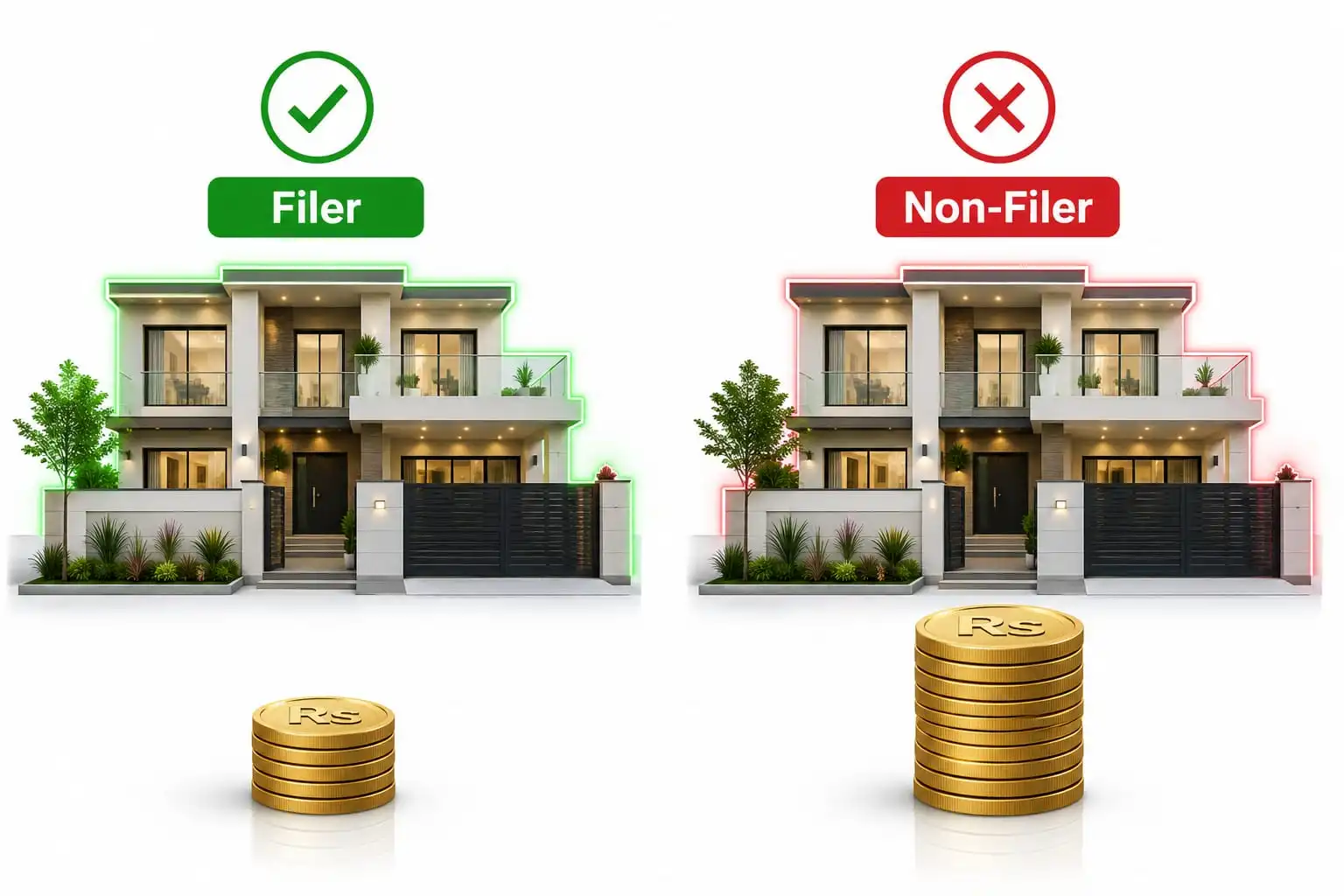
When you buy property, you pay advance income tax under Section 236K at registration or transfer. It’s calculated on whichever value is higher: the FBR-notified valuation for that area, or the provincial DC rate — you can’t declare a lower price to reduce it.
For FY 2025–26, active filers typically pay roughly 1.5%–3% depending on the value bracket, while non-filers face much steeper rates, sometimes climbing into double digits on higher-value deals. “Late filers” sit in between.
Advance Tax on Sale — Section 236C
Sellers face a mirror-image tax under Section 236C at the time of transfer. Active filers typically pay around 3%–4.5%, while non-filers can pay 10% or more. Both 236C and 236K are adjustable — the amount paid can be offset against your final income tax liability when you file your return.
Capital Gains Tax (CGT) on Property
CGT applies to your profit, not the full sale price, and the rules depend on when you bought the property:
- Acquired on/after 1 July 2024: a flat rate applies for active filers, regardless of holding period.
- Acquired before 1 July 2024: the older sliding scale still applies — the rate drops the longer you hold, reaching zero after roughly six years.
Section 7E — Deemed Income Tax: The Big 2026 Update
Section 7E, introduced through the Finance Act 2022, required resident owners to pay annual tax on “deemed income” from property valued above PKR 25 million — roughly 1% of the property’s value per year, even with zero actual rent.
Breaking — June 2026
Pakistan’s Federal Constitutional Court ruled Section 7E unconstitutional in May 2026, calling it “confiscatory in nature.” On 17 June 2026, the court released its detailed reasoning, and Parliament is now debating the Finance Bill 2026 to formally implement the ruling.
FBR’s online systems may not yet reflect this fully. If Section 7E affects you, verify the current status with FBR or a tax advisor before paying or assuming exemption.
Provincial Property Taxes: What Each Province Charges

Urban Immovable Property Tax (UIPT)
This is the annual tax most people mean when they say “property tax.” It’s charged on the Annual Rental Value (ARV) of a property, not its market price.
- Punjab applies UIPT at roughly 5% of assessed ARV; owner-occupied houses below certain size thresholds may get exemptions or reduced rates.
- Sindh applies a nominally higher percentage (around 25%) of ARV, but its assessed rental values are typically set much lower, so the final bill can end up similar.
- KPK and Balochistan run their own UIPT systems with generally lower urban coverage.
- Islamabad (ICT) follows a separate CDA-sector valuation table rather than a provincial ARV model.
Stamp Duty & Registration Fee
Every transfer also attracts provincial stamp duty and registration charges, paid at registration. Rates vary by province and are revised periodically to make documented transactions more attractive than informal transfers.
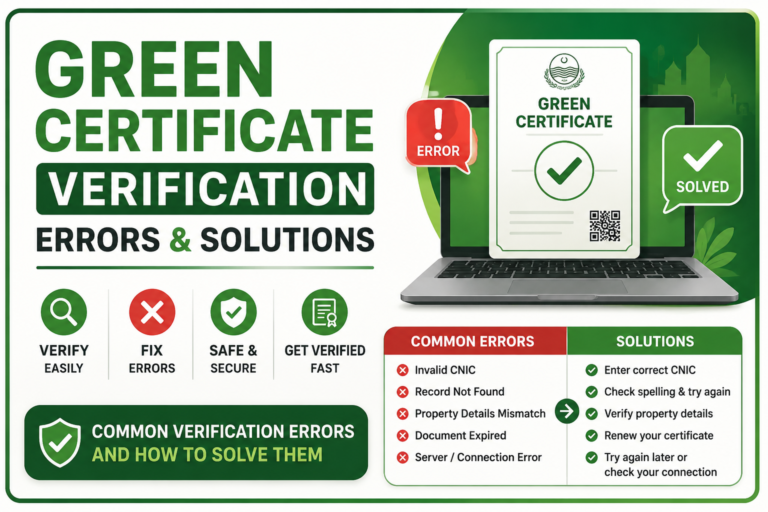
If you’re a developer or builder: real estate and construction companies in Punjab also fall under separate environmental compliance rules. See our Green Certificate requirements guide to check if your project needs one.
Filer vs. Non-Filer: Why This Status Changes Everything

| Status | Typical Behaviour | Tax Impact |
|---|---|---|
| Active Filer | Filed latest return on time | Lowest withholding tax rates |
| Late Filer | Filed late, or missed a recent deadline | Mid-range rates — roughly double an active filer’s |
| Non-Filer | Not on the Active Taxpayer List | Highest rates — sometimes several times higher |
On a high-value deal, the gap between filer and non-filer status can run into millions of rupees. Non-filers also face risk under Section 111: buying property above a certain threshold can trigger an FBR inquiry into source of funds, with heavy penalties if it isn’t satisfied.
A Practical Example: Calculating Your Tax Burden

Suppose you’re buying a plot valued at PKR 20 million per the FBR’s notified table for that area.
- Check the higher value — compare the FBR rate and the provincial DC rate; the higher one is your tax base.
- Apply your 236K rate based on filer status — an active filer might pay roughly PKR 300,000–600,000, while a non-filer could pay PKR 2 million or more.
- Add stamp duty and registration fee, charged separately by the province.
- If you sell later at a profit, factor in CGT, with the 236C advance tax adjustable against it.
- If you keep the property long-term, check whether annual UIPT or any deemed-income tax applies, subject to the 2026 Section 7E ruling.
Exemptions and Relief You Should Know About
- One capital asset rule: a resident’s single residential property has historically been treated as exempt from deemed-income tax, though this is under active review.
- Agricultural land used for farming (excluding farmhouses) generally sits outside Section 7E.
- Inherited property often carries different documentation needs — consult a tax professional case by case.
- Overseas Pakistanis investing via formal channels should still verify their ATL status before transfer to avoid being charged non-filer rates by mistake.
Common Mistakes Buyers and Sellers Make
- Assuming the agreed sale price determines the tax, when the higher of FBR value or DC rate actually applies.
- Paying token money before checking ATL/filer status, leading to surprises at registration.
- Forgetting that 236C and 236K are adjustable — many people never claim them back because they don’t file a return at all.
- Ignoring annual UIPT until a penalty notice arrives.
- Treating Section 7E as settled law without checking for updates, given the active 2026 court proceedings.
Key Takeaways
- Property tax in Pakistan combines federal withholding taxes (236C, 236K, CGT, the disputed Section 7E) with provincial taxes (UIPT, stamp duty, registration fee).
- Tax is calculated on the higher of the FBR valuation or DC rate — never on a privately negotiated lower figure.
- Filer status is the single biggest cost driver; non-filers can pay several times more than active filers on the same deal.
- Section 7E’s future is uncertain after the 2026 Federal Constitutional Court ruling — confirm the current status before assuming it applies.
- 236C and 236K are adjustable against your annual income tax, but only if you actually file a return.
- Annual UIPT is a separate, ongoing provincial obligation that continues even after transfer taxes are paid.
Frequently Asked Questions
What is the main property tax in Pakistan?
Who pays more tax, a filer or a non-filer?
Is Section 7E still applicable in 2026?
How is property tax calculated in Pakistan?
Can I get back the advance tax I paid as a buyer or seller?
Do overseas Pakistanis pay different property tax rates?
What is UIPT and how is it different from FBR taxes?
This guide reflects publicly available FBR notifications, provincial Excise & Taxation rules, and news coverage of Pakistan’s 2026 tax litigation as of June 2026. Tax law changes through annual Finance Acts and court decisions — for a transaction-specific calculation, consult a registered tax practitioner.
Ready to calculate your exact property tax?
Check your FBR Active Taxpayer status, confirm the current FBR/DC valuation for your property, and talk to a tax professional about how the 2026 Section 7E ruling affects you — before you sign anything.