What Is a Green Certificate
What Is a Green Certificate? The Complete Guide to Renewable Energy Credits in 2026
A green certificate is a tradable digital document that proves one megawatt-hour (MWh) of electricity was generated from a renewable energy source such as solar, wind, hydro, or biomass. Also known as a Renewable Energy Certificate (REC), Renewable Energy Credit, or Guarantee of Origin (GO) in Europe, it represents the environmental and social benefits of clean power, separated from the actual electricity. Businesses, governments, and individuals buy green certificates to claim renewable energy use, meet sustainability goals, and support the global energy transition.
In short: a green certificate is how the world keeps score of clean energy generation.
Understanding What is a Green Certificates: A Clear Definition
When a wind turbine in Texas or a solar farm in Spain produces electricity, two things are created at once. The first is the physical power that flows into the grid. The second is the “green attribute” — the environmental benefit of producing that power without burning fossil fuels.
A green certificate captures that second part. It separates the value of being clean from the electricity itself, allowing the environmental benefit to be sold independently.
This concept exists because once electricity enters the grid, it becomes indistinguishable. You cannot tell which electrons came from a coal plant and which came from a solar panel. Green certificates solve this tracking problem by acting as proof of origin.
Each certificate represents 1 megawatt-hour of renewable electricity, equivalent to powering roughly 330 average homes for one hour in the United States.
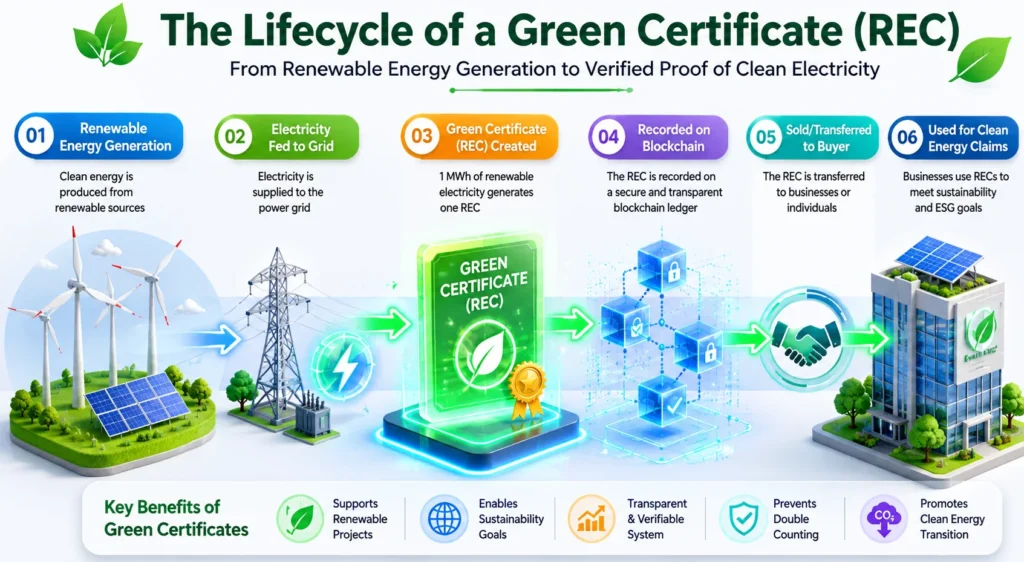
How Green Certificateis Work: The Step-by-Step Process
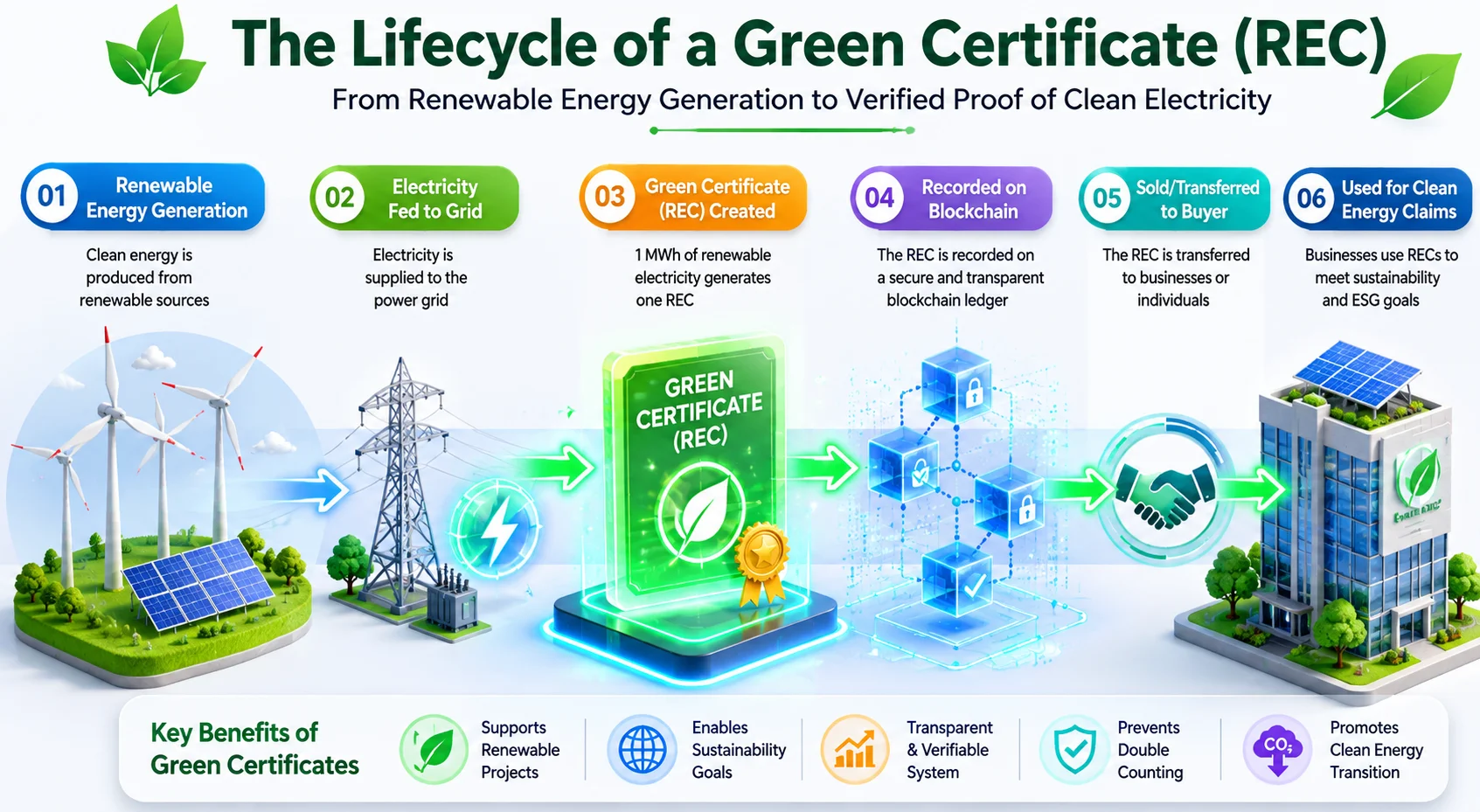
The lifecycle of a green certificate is straightforward, even if the markets behind it are complex.
- Generation: A renewable energy facility, such as a wind farm or solar park, produces electricity.
- Verification: An accredited body measures and verifies the output.
- Issuance: For every 1 MWh generated, one green certificate is issued by a registry like the M-RETS, PJM-GATS, or the European AIB Hub.
- Trading: The certificate can now be sold separately from the electricity. Buyers include corporations, utilities, and traders.
- Retirement: When a buyer “uses” the certificate to make a renewable energy claim, it is permanently retired so it cannot be counted twice.
The retirement step is critical. It prevents double-counting and gives the system its credibility.
Why Green Certificates Were Created
Before green certificates existed, companies wanting to support clean energy had limited options. They either had to build their own solar panels or sign expensive long-term contracts with renewable producers.
Green certificates opened the market. Today, a bakery in Cairo can support a wind farm in Morocco without rewiring its grid connection. A bank in Dubai can offset its electricity use with hydroelectric power from Norway.
The system also helps governments enforce Renewable Portfolio Standards (RPS) — laws requiring utilities to source a percentage of their power from renewables. Currently, more than 30 U.S. states use this model, and many countries have similar mandates.
Types of Green Certificates Around the World
Different regions use different naming conventions, but the underlying concept is the same.
| Certificate Type | Region | Issuing Body | Common Use |
|---|---|---|---|
| Renewable Energy Certificate (REC) | United States | Green-e, M-RETS, WREGIS | Compliance and voluntary markets |
| Guarantee of Origin (GO) | Europe (EU) | Association of Issuing Bodies (AIB) | EU disclosure requirements |
| International REC (I-REC) | Global (60+ countries) | I-REC Standard Foundation | Cross-border claims |
| Renewable Obligation Certificate (ROC) | United Kingdom | Ofgem | Phasing out, replaced by CfD |
| TIGR (Trade & Industry GHG Registry) | International | APX | Voluntary corporate claims |
| Indian REC | India | CERC | Meeting state RPO targets |
Each system follows local regulations but most can be traded internationally through standardized frameworks.
Green Certificates vs. Carbon Credits: Know the Difference
People often confuse green certificates with carbon credits. They are related but not the same.
| Feature | Green Certificate (REC) | Carbon Credit |
|---|---|---|
| What it Represents | 1 MWh of renewable electricity | 1 ton of CO₂ emissions avoided or removed |
| Unit | Energy (megawatt-hours) | Emissions (metric tons of CO₂e) |
| Source | Renewable power generation only | Any verified climate project (forestry, methane capture, etc.) |
| Primary Purpose | Tracking clean electricity | Offsetting greenhouse gas emissions |
| Regulatory Market | Renewable Portfolio Standards | Cap-and-trade systems like EU ETS |
A simple way to remember it: RECs are about where your electricity came from. Carbon credits are about offsetting pollution you created.
Who Buys Green Certificates and Why?
The buyer base has exploded since 2015. Global tech giants lead the way.
- Google procures enough RECs and renewable contracts to match 100% of its electricity use across data centers.
- Apple claims all its facilities and supply chain partners run on renewable energy backed by certificates and direct purchases.
- Microsoft has been buying RECs since 2012 and is now investing billions in additional clean power.
- Amazon has become the world’s largest corporate buyer of renewable energy, supported heavily by RECs.
Beyond Big Tech, banks, manufacturers, hotels, and even small spas and salons now buy green certificates to meet ESG (Environmental, Social, Governance) reporting standards and respond to customer demand for sustainable services.
According to recent market research, the global Renewable Energy Certificate market was valued at around USD 23 billion in 2025 and is projected to surpass USD 64 billion by 2035, growing at a compound annual rate near 11%.
The Real-World Impact of Green Certificates
Skeptics argue that simply buying a certificate does not put a new solar panel on the ground. That criticism is partly fair, but the picture is more nuanced.
Green certificates create financial demand for renewable generation. When a wind farm developer in Pakistan or Egypt knows it can sell both electricity and certificates, projects become more bankable. Banks lend more easily. New capacity gets built.
A 2023 review by the U.S. Environmental Protection Agency (EPA) confirmed that voluntary REC purchases helped support roughly 280 million MWh of renewable generation in the U.S. that year alone, equivalent to the annual electricity use of around 26 million American homes.
How Are Green Certificates Priced?
Prices vary widely depending on:
- Region: European Guarantees of Origin often trade for €1–€10 per MWh, while specific U.S. state RECs can exceed $300 per MWh in tight compliance markets like New Jersey.
- Energy source: Solar RECs (SRECs) usually command premium prices compared to wind or hydro.
- Vintage: Certificates from the same year as the purchase are typically more valuable.
- Certification standard: Green-e certified RECs sell for higher prices because of their strict verification.
- Market type: Compliance markets (with legal mandates) typically have higher prices than voluntary markets.
For most voluntary buyers in 2025, international RECs (I-RECs) range between $0.50 and $5.00 per MWh — making sustainability claims affordable even for small businesses.
How to Buy a Green Certificate: A Practical Guide
If your business wants to purchase green certificates, follow these steps.
- Calculate your electricity use in megawatt-hours over the year.
- Choose your standard: Green-e (US), I-REC (international), or Guarantees of Origin (Europe).
- Pick a provider: Trusted retailers include 3Degrees, ENGIE, EDF Trading, Shell Energy, Ecohz, and Statkraft.
- Match your purchase to your annual consumption.
- Receive a retirement statement confirming the certificates were retired in your name.
- Report it in your sustainability disclosure (CDP, GRI, or local ESG framework).
Common Misconceptions About Green Certificates
“They are the same as carbon offsets.” They are not. RECs track electricity origin. Carbon credits offset emissions.
“Buying RECs makes me carbon neutral.” Not automatically. RECs cover Scope 2 electricity emissions. You still need to manage Scopes 1 and 3.
“Cheap certificates mean low impact.” Sometimes true, but not always. Even low-priced I-RECs help build credibility in emerging renewable markets like Pakistan, India, Vietnam, and Egypt.
Green Certificates and the Future of Clean Energy
The market is evolving fast. New developments worth tracking include:
- Granular Certificates (GCs) that match electricity demand to renewable supply on an hourly basis, championed by Google and Microsoft.
- 24/7 carbon-free energy programs supported by the United Nations Energy Compact.
- Blockchain-based REC registries improving transparency and reducing double-counting.
- Cross-border green certificate trading, allowing companies in regions like the GCC to claim renewables sourced from neighboring countries.
These innovations are pushing the system toward higher accuracy and stronger climate impact.
Key Takeaways
- A green certificate equals 1 MWh of verified renewable electricity.
- Common names include REC (US), GO (Europe), I-REC (international), ROC (UK).
- They are different from carbon credits, which measure CO₂ avoided.
- Major buyers include Google, Apple, Microsoft, and Amazon.
- The global REC market is expected to grow from USD 23 billion (2025) to USD 64 billion (2035).
- Use them to meet ESG goals, RPS mandates, and net-zero commitments.
- Always buy from certified providers like Green-e or the I-REC Standard Foundation.
Frequently Asked Questions
Common questions about Green Certificates, RECs, carbon credits, and renewable energy compliance.
A Green Certificate proves that one megawatt-hour (MWh) of electricity was generated from a renewable energy source and delivered to the electricity grid.
No. A Green Certificate represents 1 MWh of renewable electricity generation, while a Carbon Credit represents 1 metric ton of carbon dioxide (CO₂) emissions avoided or removed.
Yes. Many renewable energy providers and sustainability platforms allow households and individuals to purchase Green Certificates to offset their electricity consumption.
Most Green Certificates must be retired within 12 to 24 months after issuance, depending on the certification program and regional regulations.
Yes. Organizations such as Green-e, the Association of Issuing Bodies (AIB), and the I-REC Standard Foundation maintain strict standards to prevent fraud and double-counting.
Not directly. Green Certificates support renewable energy generation financially, which helps reduce dependence on fossil fuels and lowers emissions over time.
Green Certificates are widely used in the United States, Germany, the Netherlands, Norway, the United Kingdom, India, Brazil, China, and the UAE.
No. RECs are primarily used in North America, while I-RECs follow an international framework recognized across more than 60 countries worldwide.