Green Certificate for Commercial Properties: Complete 2026 Guide
Everything commercial property owners, developers, and business operators need to know about obtaining environmental certification in Punjab, Pakistan — requirements, process, costs, and real benefits.
A Green Certificate for commercial properties in Punjab, Pakistan is an official environmental compliance document issued by the Punjab Environmental Protection Department (PEPD). It confirms that a commercial building or business premises meets the 2026 environmental standards — covering energy efficiency, waste management, air quality, and water use. Any commercial property with significant environmental impact is legally required to hold one. The application takes 3–5 weeks and costs between 15,000–50,000 PKR depending on business size.
What Is a Green Certificate for Commercial Properties?
If you own or operate a commercial property in Punjab — whether it’s an office tower, a shopping plaza, a hotel, a hospital, or a factory building — the green certificate is no longer a “nice to have.” Since the updated 2026 regulations took effect, it is a legal requirement for any commercial premises that has a measurable environmental footprint.
Put simply, a green certificate for commercial properties is official proof that your building and the business operating within it complies with Pakistan’s National Environmental Quality Standards (NEQS) and Punjab’s own stricter 2026 benchmarks. The certificate is issued by the Punjab Environmental Protection Department (PEPD) after a formal review of your premises, operations, documentation, and physical site inspection.
Think of it the same way you think about a fire safety certificate or an occupancy permit. Without it, you’re not just out of compliance — you’re exposed to fines, contract disqualification, and in serious cases, forced closure.
In 2026, Punjab increased its environmental compliance standards by 30%. Commercial properties that were compliant under 2024 rules may no longer qualify without upgrades. Businesses must now conduct quarterly audits instead of annual ones, and emission limits have been tightened across all commercial categories.
🔑 Key Takeaways
- Green certificates are mandatory for most commercial properties in Punjab under 2026 environmental rules
- The certificate is issued by PEPD and remains valid for 3 years before renewal
- Commercial properties can save 15–30% on operating costs through energy efficiency improvements required for certification
- Non-compliance penalties include fines up to 5 million PKR and potential business closure
- Certified commercial properties gain priority access to government contracts and attract premium tenants
- The full application process typically takes 3–5 weeks with professional preparation
- Tax incentives of 5–10% are available to certified green commercial premises for 3 years
Which Commercial Properties Need a Green Certificate?
One of the most common questions commercial property owners ask is: “Does my building actually need one?” The answer depends on what category your property falls under. Here’s a clear breakdown:
| Commercial Property Type | Green Certificate Required? | Key Environmental Concern |
|---|---|---|
| Office Buildings (10+ floors) | ✅ Yes — Mandatory | Energy consumption, HVAC emissions, waste generation |
| Shopping Malls & Plazas | ✅ Yes — Mandatory | High electricity usage, solid waste, air conditioning load |
| Hotels & Hospitality Venues | ✅ Yes — Mandatory | Water usage, food waste, chemical cleaning agents |
| Hospitals & Clinics | ✅ Yes — Mandatory | Biomedical waste, chemical disposal, emissions |
| Warehouses & Logistics Hubs | ✅ Yes — Required if fleet >10 vehicles | Fleet emissions, fuel storage, noise pollution |
| Restaurants & Food Courts | ⚠️ Conditional | Grease trap compliance, food waste, LPG emissions |
| Small Retail Shops (<500 sq ft) | ❌ Usually Exempt | Minimal environmental impact |
| Co-working Spaces | ⚠️ Conditional (depends on size) | Energy usage, waste management |
If you’re unsure whether your property qualifies for exemption, the safest path is to check the official eligibility criteria or contact PEPD directly. Operating without a required certificate is a risk no business owner should take.
Green Certificate Requirements for Commercial Buildings
Commercial properties face a more comprehensive checklist than small businesses. The standards are higher because the environmental footprint is larger. Here’s what PEPD looks at when assessing your commercial property:
1. Energy Efficiency Standards
Commercial buildings in Punjab must demonstrate active energy management. This means having energy-efficient lighting (LED systems), smart HVAC controls, insulated building envelopes, and — for larger buildings — a portion of electricity sourced from renewable installations. PEPD assesses your 12-month utility bills alongside the building’s rated load capacity.
2. Waste Management Systems
Your property must have documented waste segregation systems — separating recyclable, general, and hazardous waste. Hotels and hospitals face additional scrutiny for specialized waste streams. You’ll need contracts with PEPD-approved waste handlers and monthly disposal logs.
3. Water Conservation Compliance
Water recycling systems, rainwater harvesting where applicable, and wastewater treatment are assessed. Commercial kitchens must demonstrate compliant grease trap systems. The property’s water consumption must be within PEPD benchmarks for its building type.
4. Air Quality Control
Diesel generator emissions, HVAC refrigerant types, vehicle movement on-site, and chimney emissions (for industrial-commercial hybrids) are all measured. Properties running older diesel generators may need upgrades or offsets.
5. Noise Pollution Limits
For properties in mixed-use or residential-adjacent zones, noise levels must remain below 70 dB during daytime and 55 dB at night. Properties with large generators, compressors, or event spaces need acoustic management documentation.
Punjab’s 2026 revisions mean commercial properties previously certified under 2023 or 2024 rules must undergo a compliance gap assessment. Standards for refrigerant types, generator emission controls, and water discharge limits have all been updated. Don’t assume your old certificate covers current requirements.
Full Documentation Checklist for Commercial Properties
Getting your paperwork right from the start is the single biggest time-saver in the certification process. PEPD returns incomplete applications, which adds weeks to your timeline. Here is what commercial property owners must submit:
- ✅ Completed application form GC-2026-P (available from PEPD or their online portal)
- ✅ Valid business registration certificate and commercial trade license
- ✅ Environmental Impact Assessment (EIA) prepared by a PEPD-certified consultant
- ✅ Building completion certificate and approved layout plans
- ✅ Energy audit report covering the past 12 months
- ✅ Waste management agreement with licensed disposal contractor
- ✅ Water quality test results (for properties with on-site water treatment)
- ✅ Proof of pollution control equipment installation (generators, HVAC, exhausts)
- ✅ Generator emission test certificate (if applicable)
- ✅ Noise level assessment report from accredited lab
- ✅ Staff environmental training records
- ✅ ISO 14001 certification or documented internal Environmental Management System (EMS)
- ✅ Site photographs clearly showing all compliance measures
Step-by-Step Application Process
The process for commercial properties mirrors the general green certificate process but with additional scrutiny at the inspection phase. Here’s what to expect:
Internal Compliance Audit (2–3 weeks before applying)
Hire a certified environmental consultant to assess your property against current PEPD standards. Identify gaps in energy systems, waste handling, water management, and documentation. Fix what you can before applying — this avoids inspection failure.
Prepare Your EIA Report
Your consultant prepares a formal Environmental Impact Assessment. For large commercial properties this is a detailed technical document — not something you can write yourself. Budget 2–3 weeks and 30,000–80,000 PKR for this, depending on property size.
Submit Application to PEPD
Submit online via the PEPD portal or in person at your regional office. Pay the application fee: approximately 15,000 PKR for smaller commercial premises, 50,000+ PKR for large buildings. Retain your receipt and reference number.
Document Review (5–7 days)
PEPD reviewers check your submission for completeness. Respond to any clarification requests within 3 working days to avoid delays. Incomplete submissions are returned — which restarts the clock.
On-Site Inspection (1 day)
PEPD environmental officers visit your property. They test actual equipment performance, verify installed pollution controls, take environmental samples, and cross-check against your EIA claims. Be present and have your property manager ready to answer questions.
Lab Testing (7–14 days)
Air, water, and noise samples are sent to PEPD-approved laboratories. Results are benchmarked against Punjab’s 2026 NEQS standards. This phase is outside your control — focus on ensuring everything was correctly installed and operational during inspection.
Approval and Certificate Issuance (3–5 days)
Successful properties receive a Green Certificate valid for 3 years, registered publicly in PEPD’s database. You can display this certification in your property and use it in marketing and government tender applications.
To understand the full application process in detail, visit our dedicated guide: How to Apply for Green Certificate.
Real Benefits for Commercial Property Owners
If you’re treating the green certificate purely as a compliance burden, you’re missing the commercial upside. Here’s why smart property owners in Lahore, Islamabad, and across Punjab are proactively pursuing certification:
Financial Returns
Operating cost reduction of 15–30%. The energy efficiency upgrades required for certification — LED lighting, improved HVAC, insulation, smarter water management — pay for themselves. A mid-sized commercial plaza spending 400,000 PKR/month on utilities can realistically save 60,000–120,000 PKR monthly after certification-driven improvements.
Tax incentives. Punjab’s government offers 5–10% tax deductions for certified green businesses and properties for 3 consecutive years. For commercial property owners, this can be a meaningful annual saving on property and income tax assessments.
Market and Tenant Advantages
Premium corporate tenants — multinationals, NGOs, government agencies — increasingly require their leased commercial space to hold environmental certification. A green-certified office building in Lahore or Islamabad can command 10–20% higher rental premiums compared to uncertified equivalents. Vacancy rates also tend to be lower because environmentally conscious tenants sign longer leases.
Government Contract Eligibility
Many government procurement and leasing tenders now mandate that commercial premises suppliers hold active green certification. Without it, your property is simply invisible to a large portion of the institutional tenancy market.
A commercial plaza owner in Lahore invested approximately 800,000 PKR in energy efficiency upgrades and green certification in early 2026. Within six months, utility bills dropped by 22%, a government agency signed a 3-year lease at 15% above market rate, and the property qualified for a tax deduction saving 180,000 PKR in the first year. Total net payback: under 18 months.
Property Valuation and Investment Appeal
Green-certified commercial properties in Pakistan’s urban centres are beginning to attract ESG-focused investment from institutional funds and real estate investment trusts (REITs). SECP-regulated funds increasingly screen for environmental compliance when considering commercial real estate assets. Certification strengthens your asset’s long-term valuation narrative.
Costs Involved in Getting Certified
Transparency on costs matters. Here’s a realistic breakdown for a mid-sized commercial property:
| Cost Category | Estimated Range (PKR) | Notes |
|---|---|---|
| PEPD Application Fee | 15,000 – 50,000 | Varies by property size and commercial category |
| EIA Report (Consultant) | 30,000 – 120,000 | Larger/complex properties require more detailed assessments |
| Energy Audit | 20,000 – 60,000 | 12-month audit by certified energy auditor |
| Lab Testing (Samples) | 15,000 – 35,000 | Air, water, noise samples at PEPD-approved labs |
| Equipment Upgrades | 50,000 – 500,000+ | Depends on current compliance gaps (HVAC, generators, etc.) |
| Staff Training | 10,000 – 25,000 | Environmental compliance training records required |
| Total Estimated (typical) | 140,000 – 790,000 | Highly variable; properties in good condition pay less |
The wide range reflects real-world variance. A well-managed office building already running LED lighting and proper waste management might need only the application fee, EIA, and lab testing. A poorly maintained commercial complex may need substantial investment before it can even apply. A pre-application compliance audit is money well spent — it tells you exactly where you stand before you commit to the full process.
Green Certificate vs. Other Commercial Property Certifications
Commercial property owners in Pakistan sometimes confuse the PEPD Green Certificate with other environmental or property certifications. Here’s a quick comparison:
| Certification | Issued By | Scope | Mandatory in Punjab? |
|---|---|---|---|
| PEPD Green Certificate | Punjab Environmental Protection Dept. | Environmental compliance — operations | ✅ Yes (2026 rules) |
| ISO 14001 | International Organization for Standardization | Environmental Management Systems | ⚠️ Required as supporting evidence |
| LEED Certification | USGBC (USA-based) | Building design & construction sustainability | ❌ Voluntary, internationally recognized |
| Property File / Title Deed | Land records authority | Ownership documentation | ✅ Always required (separate document) |
| Fire Safety Certificate | Civil Defence / local authority | Fire prevention compliance | ✅ Separate mandatory requirement |
For a deeper comparison of documentation types, read: Green Certificate vs Property File — What’s the Real Difference?
Common Mistakes Commercial Properties Make During the Application
After reviewing hundreds of applications, these are the errors that most often result in delays or outright rejection:
- Submitting an outdated EIA: Assessment reports older than 6 months at time of submission are typically rejected.
- Undocumented equipment: Pollution control equipment must have purchase invoices, installation certificates, and recent maintenance records — not just physical presence.
- Inconsistent data: If your utility bills show 200,000 PKR/month in electricity spend but your EIA claims low energy consumption, PEPD will flag the discrepancy.
- Wrong application form version: PEPD updated their forms for 2026. Using Form GC-2024-P instead of GC-2026-P is a common and entirely avoidable mistake.
- No staff training records: Environmental awareness training is mandatory — and frequently overlooked.
- Failing to notify PEPD of changes: If your property underwent renovations or added a generator after your audit, you must declare this.
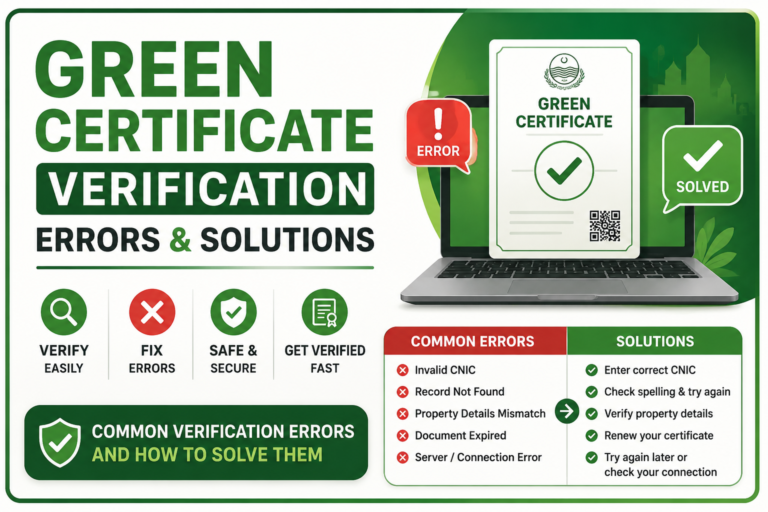
If your application was rejected or flagged, read our guide on Green Certificate Verification Errors and Solutions.
Renewal: What Happens After 3 Years?
Your Green Certificate is valid for 3 years. Renewal isn’t automatic — you must initiate the process before expiry to avoid a compliance gap. The good news: renewal is faster and cheaper than initial certification, typically 2–3 weeks and roughly 60% of the original cost, provided your property has maintained continuous compliance and passed annual maintenance audits.
Properties that have been proactive — maintaining quarterly internal audits, staying current with environmental records, upgrading equipment proactively — sail through renewal. Those who let standards slip during the 3-year period face the same scrutiny as first-time applicants.
Frequently Asked Questions
Is a green certificate mandatory for all commercial properties in Punjab?
Not all, but most. Commercial properties with significant environmental impact — office buildings, malls, hotels, hospitals, warehouses — require mandatory certification under Punjab’s 2026 rules. Very small commercial spaces under 500 sq ft with minimal environmental impact may qualify for exemption. When in doubt, check the full eligibility guide or contact PEPD directly.
How long does the green certificate application take for a commercial property?
The complete process typically takes 3–5 weeks from submission to certificate issuance — provided your documentation is complete and your property passes inspection without requiring corrective actions. Pre-application preparation (internal audit, EIA report) can add another 2–4 weeks. Plan for 6–8 weeks total from decision to certificate.
Can I still operate my commercial property while the green certificate application is pending?
Yes. You can continue operating while your application is under review. However, you must still maintain full environmental compliance during this period. PEPD can inspect your premises at any time, and operating in violation of environmental standards — even during the review period — can result in penalties.
What happens if a commercial property fails the PEPD site inspection?
PEPD issues a detailed non-compliance report identifying every area that failed. You typically receive 30 days to implement corrective actions before requesting a re-inspection. Most commercial properties pass the re-inspection after addressing the identified issues. Major failures — such as absent pollution control systems — may require longer remediation timelines.
How much does a green certificate cost for a commercial building?
All-in costs typically range from 140,000 to 790,000 PKR, depending on the size and current compliance status of the commercial property. The PEPD application fee alone ranges from 15,000–50,000 PKR. Larger buildings with compliance gaps requiring equipment upgrades will sit at the higher end of the cost range. A pre-application audit helps estimate your specific costs before committing.
Can I transfer a green certificate to a new owner if I sell my commercial property?
No. Green Certificates are issued to specific business entities and are non-transferable. If a commercial property is sold, the new owner must initiate a fresh certification application. This is an important due diligence point for commercial property buyers — always verify a property’s environmental compliance status before purchase. See our guide on why property verification matters.
Does an overseas Pakistani need to be physically present to get a green certificate for their commercial property?
No. Overseas Pakistanis can authorize a representative or consultant to manage the application process on their behalf. Read the full guide on Green Certificate for Overseas Pakistanis for the specific documentation and authorization process involved.
How do I verify if a commercial property already holds a valid green certificate?
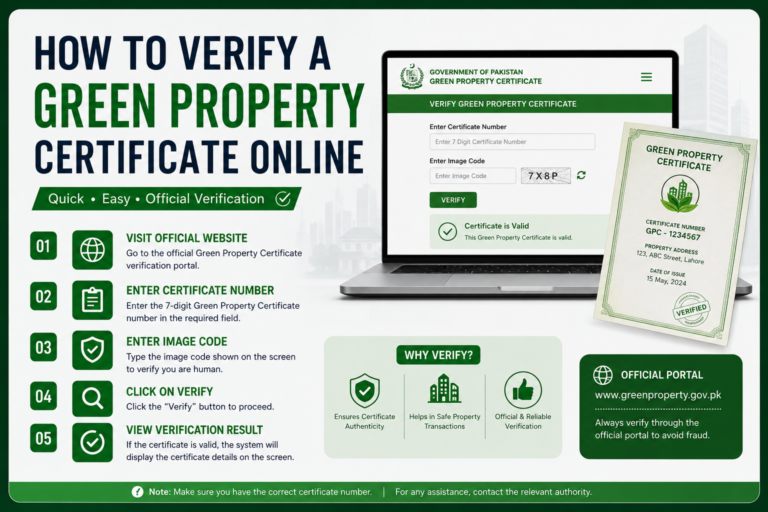
You can verify any property’s green certificate status through the official PEPD portal at pepd.gop.pk, or through our dedicated online verification guide at How to Verify a Green Property Certificate Online. Verification takes under 5 minutes and is critical for buyers, tenants, and investors.
Conclusion: Green Certification Is a Commercial Advantage, Not Just a Compliance Box
The commercial property landscape in Punjab is shifting. Tenants are more environmentally aware. Government procurement increasingly favors certified suppliers. Investors are screening for ESG compliance. And regulators have real enforcement teeth — with penalties up to 5 million PKR for non-compliance.
Getting a green certificate for your commercial property in 2026 isn’t just about avoiding a fine. It’s about positioning your asset for the market realities of the next decade. The properties that will command premium rentals, attract institutional tenants, qualify for government contracts, and maintain strong valuations are the ones with verified environmental credentials.
The process is clear, the costs are manageable, and the returns — in reduced operating expenses, tax savings, and rental premiums — make the investment straightforward to justify. Don’t wait until a tender rejection or a PEPD notice forces your hand. Start your certification journey today.
Ready to Get Your Commercial Property Green Certified?
Start with our complete requirements guide or go straight to the application process. Our step-by-step resources walk you through every stage — from pre-audit preparation to certificate issuance.
Start Your Application → Check Requirements